
Wounds Made Visible
Art as a Resting Place

“Art in different forms continues to express what is in the collective psyche
while offering needed medicine”
~Dr. Chanti Tacoronte-Perez
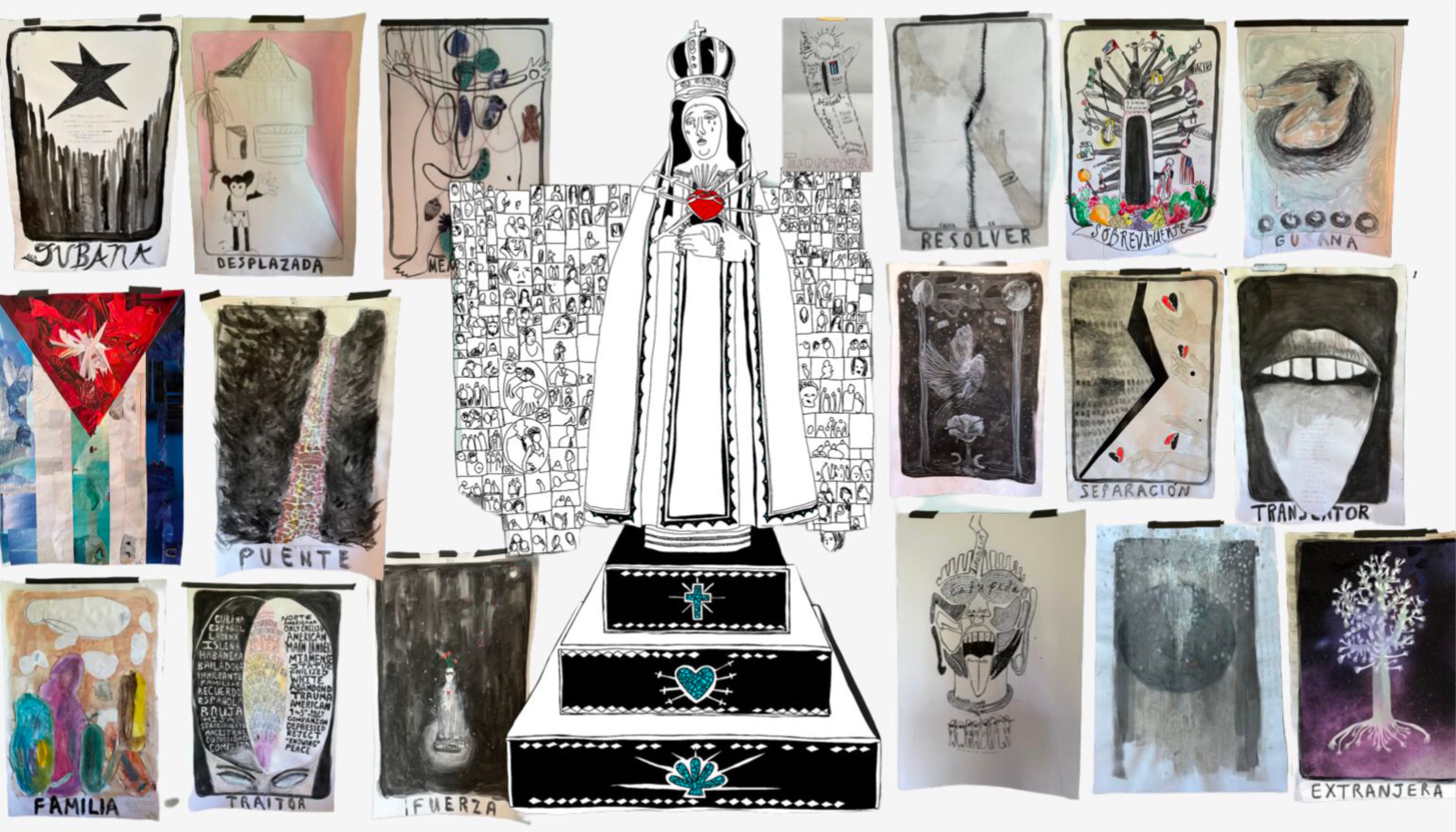
Approaching the image of the wound in song, mythology, or art usually stirs something within us, perhaps about our wounds. When we look at Frida Kahlo's paintings, listen to the music and lyrics of Los Van Van, or read Gloria Anzaldua's words, we witness their wounds. These images become paths that can reflect and resemble our wounds and, therefore, activate those parts of us. As you read this article, take your time, pause, make notes, doodle, and daydream; notice what you imagine, feel, and reflect on. It might be a threshold to welcome your wounds and slowly explore them.
Hiding one’s woundedness adds pain and burden to one’s body—the wound-holder.1 For some, talking about the wound repeatedly can keep the wound in place, like a scratch in a record, the same scenario is replayed by ruminating on the wounding, thus etching it more deeply in the psyche. Moreover, for someone like me, who finds it difficult to express myself using my voice, talking about my woundedness is a huge barrier, an impossibility for the most part. The arts, on the other hand, open other means of communication and transformation. Art making (drawing, painting, writing, moving, singing, collaging) has provided me the terrain to be in a relationship with my shadow and complexes while simultaneously giving those wounds a voice, and a place to rest. These kinds of creative expressions can help keep us from completely identifying with the wounded parts by externalizing them and giving them space. As Jung stated, “The essential thing is to differentiate oneself from these unconscious contents by personifying them, and at the same time to bring them into relationship with consciousness. That is the technique for stripping them of their power”.2 The wound can be liberated from the body, seen, changed, imagined, taken apart, and collaged in a new way. In my experience, the more one works with the arts, the arts reciprocate and work in service to the psyche.
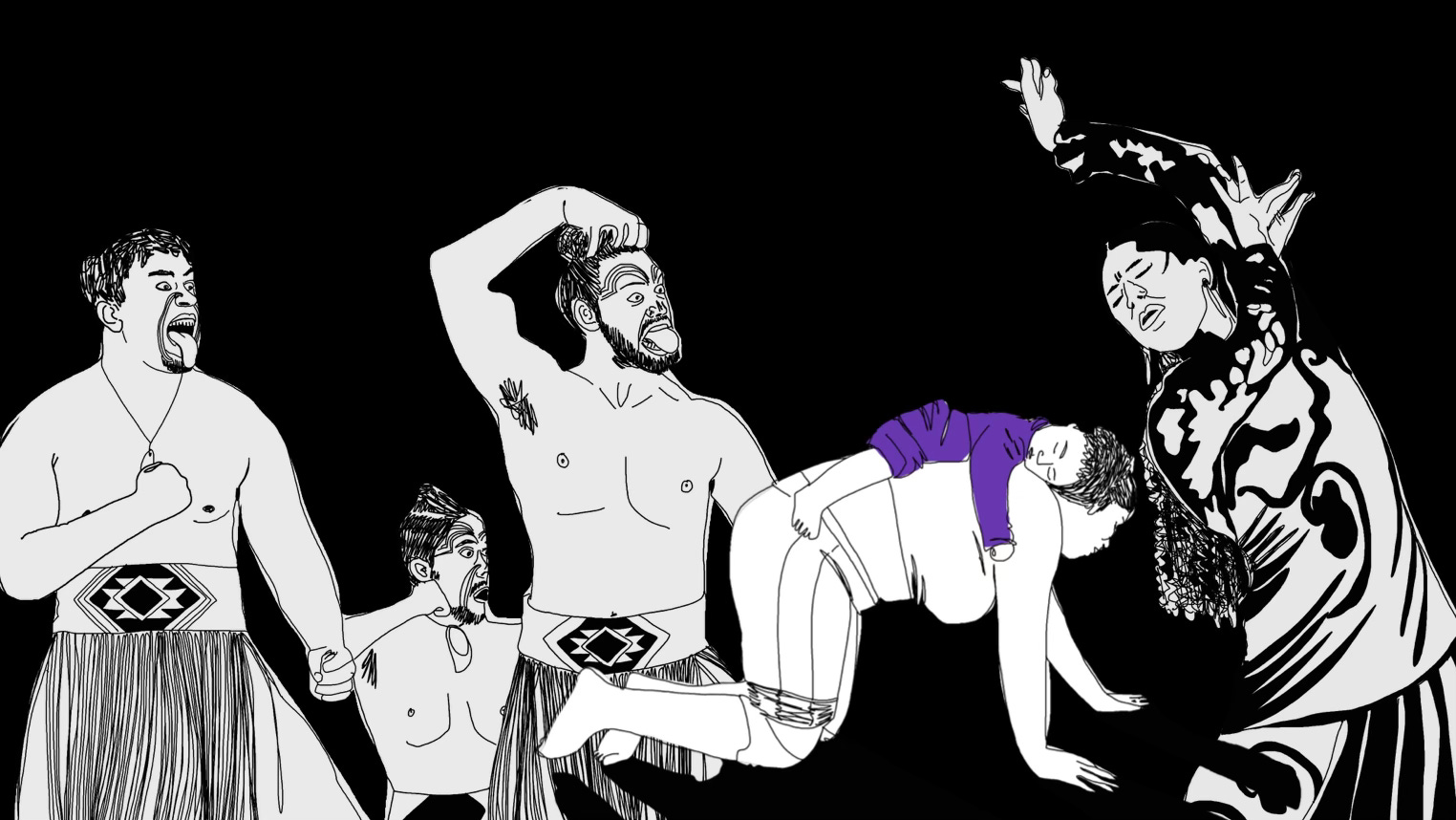
Indigenous cultures that honor the wounds and acknowledge miracles through ritual and artistic expression exemplify the relationship between one, the soul, and the sacred (that which is beyond complete comprehension). The Maori people of New Zealand express blessings and wounding with Haka, a ritual dance often performed in a group to express welcoming, lament, and pain.3 For the Cuban people, el día de San Lázaro honors the Catholic St. Lazarus who is indistinguishable from the Yoruba Babalú Ayé, earth God of smallpox, plagues, and leprosy. On December 17, thousands of devotees worship at the Sanctuary of San Lazaro, El Rincón. Creyentes, or believers, often make a long and uncomfortable voyage (walking on their knees, carrying heavy objects, or crawling). They view their journey “as a ritually efficacious way to express gratitude for miracles they have already experienced or hoped for miracles yet to come” .4 Unless speaking directly to the devotees it is difficult to distinguish between those asking for healing and those grateful for a received miracle.
Additionally, in Mexico and for much of the Latinx diaspora, November 2nd commemorates, el Día del los Muertos, a day in recognition of the thinning of the veil between the living and the dead—a day to connect, honor, and remember one’s ancestors.5 On this day, ofrendas, or ancestor altars are created and can include pictures of past relatives, favorite food, sweets, spirits, flowers, and anything else that might lead the dead home. This ritual offering displays the conviction that “one’s wellbeing depends, in part, on respectfully remembering the dead”.6 All these examples across cultural borders share an external display, container, or expression created for wounding, remembrance, and gracias.
At the end of 2020 the U.S. National Aeronautics and Space Administration (NASA) asked the public what they would take with them on a space exploration to the moon, given that since the Gemini Program in 1961 astronauts have been allowed to take with them no more than a 6” x 7” drawstring bag (about the size of a lunchbox). Imagine what you would place in that small bag as remembrances of your past and your culture if you were given the opportunity to travel to an unknown place, like Mars, Saturn, or Jupiter—knowing the high risk of leaving Earth. Typically, what North American astronauts have carried with them includes “family photos, organizational flags, t-shirts, ball-caps, books, religious texts, and personal mementos”.7
Prior to the advent of photography, the Spanish conquistadores venturing toward the unknown brought with them painted images of their trusted saints to support their journey.8 Being in possession of these icons was a sign of status—of being in proximity to divine energy, like the feeling of being in a sanctified house of God. As a result, colonized Mexico began producing these images; what is now known as a mostly Mexican tradition comes from conquest and various rivers of culture, including the Catholic santos of Spain, influenced artistically by Flemish woodcuts, etchings, and engraving alongside European works of the period.9 Paradoxically, the wound of colonialism to the collective psyche in Mexico produced this new way of coming close to the imago dei. In this way, what was once tradition and dogma (of the church and the conquistadores) has been reclaimed and re-imaged by artists. Art in different forms continues to express what is in the collective psyche while offering needed medicine.
In 1492 the Spanish monarchy gave Columbus their blessing to colonize any islands or continents thought to have gold; among them was Cuba. This conquest decimated the native Taino people and introduced the first enslaved Africans the island (Martínez-Fernández, 2018). It is worth pausing here to remember what the colonists and astronauts brought with them to cross new frontiers and to inhabit new places. Now, imagine for a moment, you are taken from your land or must spontaneously flee; you have little to no option to bring valued family heirlooms, images, or sculptures of divine idols, nor any tangible traditional relics. What many enslaved peoples brought and what refugees forced to leave their homeland continue to bring with them are the prayers in their hearts, the songs of their homeland, their language, reimagined recipes, their skills, worldviews, and beliefs.
An example of this is found in Cuba, where the enslaved Africans brought their Yoruba Gods and Goddesses, which had to be blended with the Spanish Catholic saints to survive (Lefever, 1996).10 Today, in Cuba, Santeria is a belief system that blends African Gods and Goddesses and Spanish-Catholic saints. When one honors Chango (God of thunder, owner of fire and associated with war) one also uplifts Santa Barbara (patron saint of miners, armourers, artillerymen—associated with rebellion and lightning); they are both venerated because it is believed that the Catholic saints made space for the Yoruba gods to be worshiped. A Yoruba practitioner once shared with me that because of its blended practices, Cuban Santeria is inaccurate. He explained that Cuban santero’s pronunciation is incorrect and does not come from the primary source.11 Although that may be true, that does not take away from the Cuban’s worship or the authenticity of the rituals and practices that connect them to their belief system. However inconsistent and untraditional it may be, a necessary blending of cultures, disciplines, and rituals is oftentimes what keeps traditions alive, and makes their survival possible.
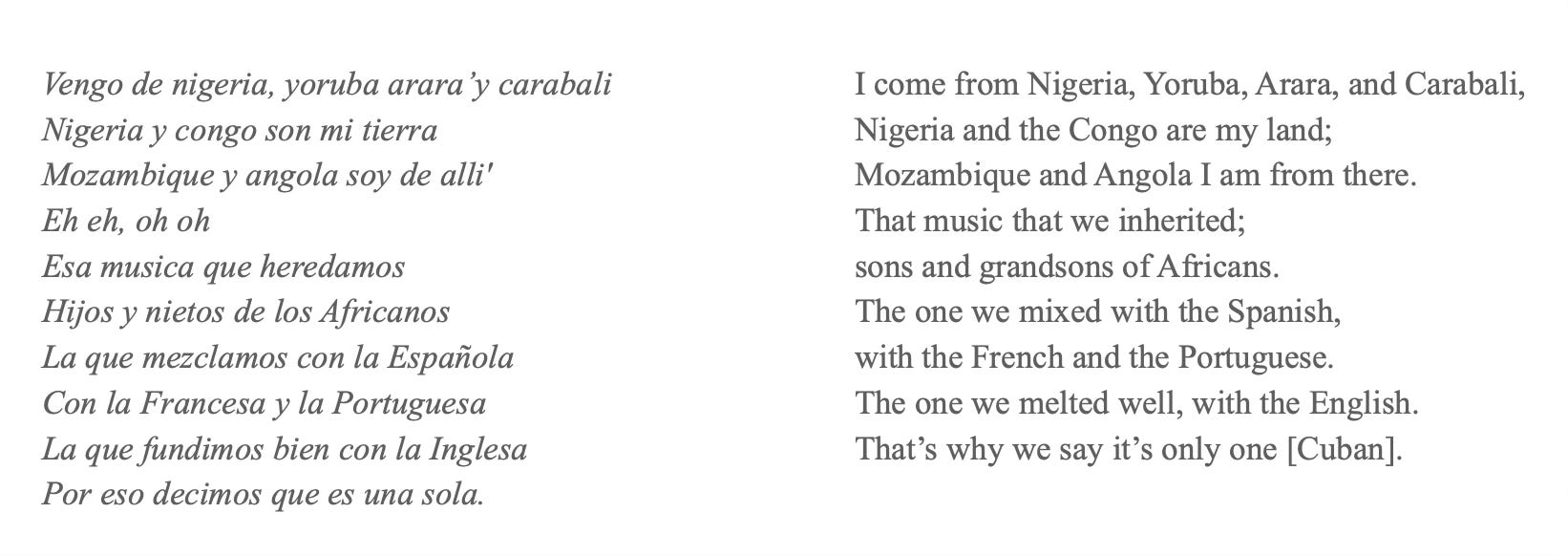
Colonialism wiped out many traditions, and because of it, colonized peoples created ways of resolviendo, or resolving cultural conflict—surviving with both the physical wounds and inherited psychic wounds. Los Van Van, a post-revolutionary Cuba-based orchestra, founded by bassist Juan Formell in 1969, explained that resolviendo is both blessing and wounding. The song titled “Eso te Pone La Cabeza Mala”—which translates to “That Messes With Your Head”—paid homage to a Cuban mixed lineage. As a musical tribute to lineage it echoes through the güiro (percussion instrument) and clave in cadence with the bell and in the rhythms of rock with swing, samba, and merengue. The lyrics12 of the song (in the original Spanish followed by author’s translation) express resolviendo:
The external display, or expression of resolviendo, is art; a place where wounding is made visible, a space to express gratitude or to ask for divine support. Creating puts one in touch with the pain—whether physical, emotional, or spiritual. Giving the wound a tangible form and an altar on which to rest offers one space to witness the wound from a different perspective and can begin to provide momentary relief from being the only one "charged" with pain.13
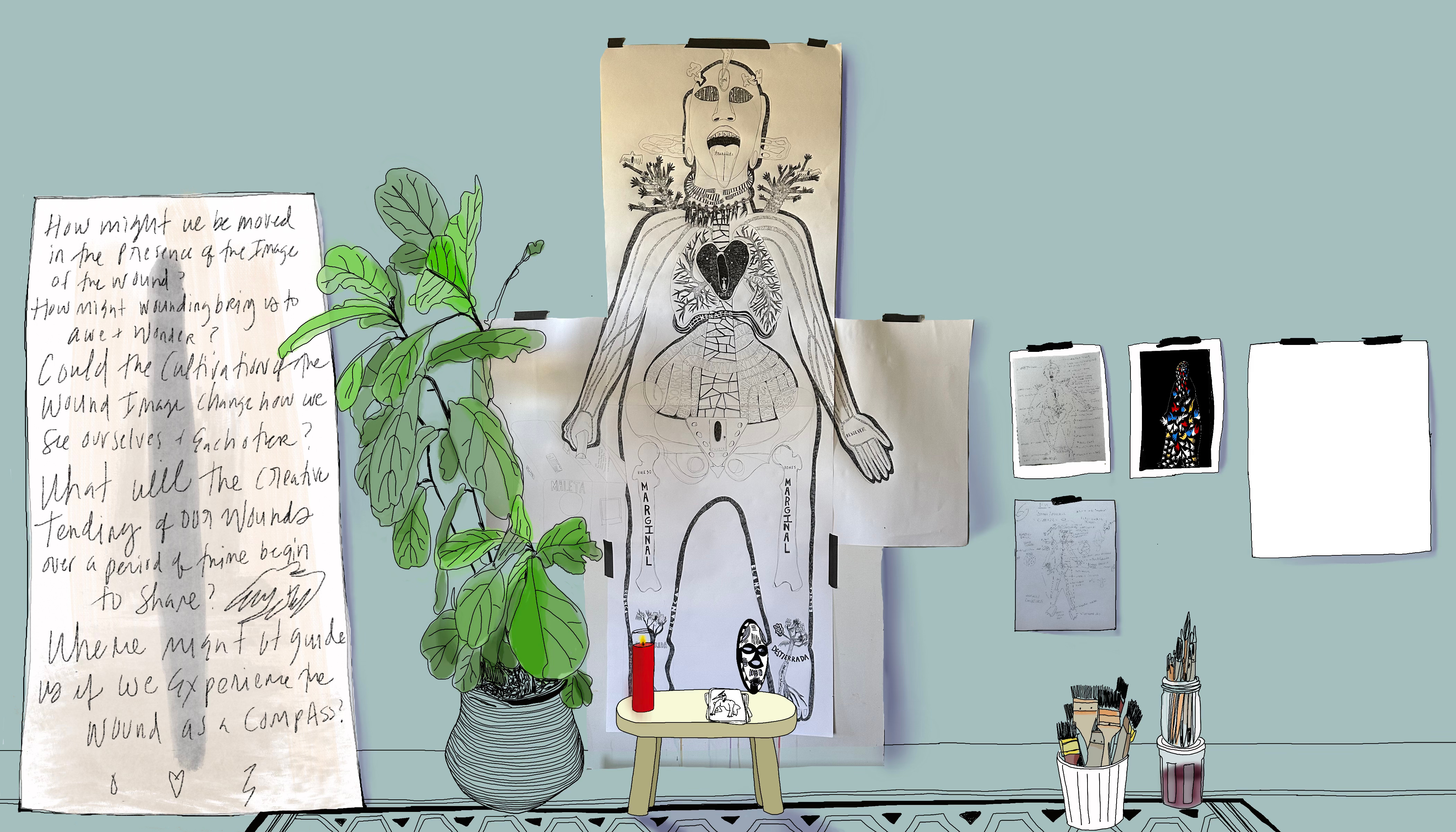
An Altar to Rest the Wound
🌕 Full moon in Virgo ♍︎ Saturday February 24, 2023 (5:30am MST)
Under the light of this full moon, consider creating an altar for the wounds—known, unknown, understood, uprooted, ancestral, communal, or personal. Note you do not need to name or know the wound(s) you are placing on the altar; remind yourself the wound is the residue, what's left, a scar from some event that can't be undone.
Altar: A Place to Rest
Find or create a sacred, supportive, and welcoming space. It could be a literal space in a room, in nature, by a tree, or a water source. You can also create a traveling altar from a small box or container.
Votive: Make Wounds Visible
A votive or ex-voto is an offering that honors the creative spirit and taps into its healing potential since its construction requires spontaneity, devotion, and surrender. To make the wound tangible, you can create a drawing, choose an oracle card, or find a rock or object to offer at the altar as a symbolic representation of the wound(s).
Offerings
In addition to the votive, you may want to make elemental offerings on your altar. You can offer water, food, flowers, burn incense, light a candle, ring a bell, sing, hum, or make a special, sacred, or magical offering.
Meditation for Offering Wounds
Find a comfortable place to sit or rest in front of your altar. You may want to have your votive, any offerings you may want to make, your journal, and your writing tool. The meditation allows time and space for you to sit in silence for as long as you like. To transition, re-orient yourself into your space; notice the sounds, deepen your breathing, look around the room, and eventually let your eyes rest on the altar. Then, note your observations and imaginings in your journal by doodling or free writing.
Dr. Chanti's Substack is a reader-supported publication. You can expect both theory and practice—nerdy-scholarly articles, creative invitations, and liminal practices that support. To receive new posts and support my work, consider becoming a free or paid subscriber.
Van der Kolk, B. (2014). The body keeps the score: Brain, mind, and body in the healing of trauma. Penguin.
Jung, C. G. (1963). Memories, dreams, reflections (A. Jaffe, Ed.; R. Winston & C. Winston, Trans.). Vintage Books. (Original work published 1961)
Kāretu, T. (1993). Haka!: The dance of a noble people. Reed Books.
Hagedorn, K. J. (2002). Long day’s journey to Rincón: From suffering to resistance in the procession of San Lázaro/Babalú Ayé. British Journal of Ethnomusicology, 11(1), 43–69. http://www.jstor.org/stable/4149885
Zavaleta, A., & Salinas, A., (2009). Curandero conversations: El niño fidencio, shamanism and healing traditions of the borderlands. Author House.
Marchi, R. (2013). Hybridity and authenticity in US Day of the Dead celebrations. The Journal of American Folklore, 126(501), 272–301. https://doi.org/10.5406/jamerfolk.126.501.0272
Patrinos, T. (2020). The personal preference kit: What astronauts take with them to space. https://www.nasa.gov/feature/the-personal-preference-kit-what-astronauts-take-with-them-to-space
ibid
Durand, J., & Massey, D.S., (1995). Miracles on the border: Retablos of Mexican migrants to the United States. University of Arizona Press.
Lefever, H. G. (199). When the saints go riding in: Santeria in Cuba and the United States. Journal for the Scientific Study of Religion, 35(3), 318–330. https://doi.org/10.2307/1386562
Personal communication, May 29, 2020)
Vengo de nigeria, yoruba arara’y carabali
Nigeria y congo son mi tierra
Mozambique y angola soy de alli'
Eh eh, oh oh
Esa musica que heredamos
Hijos y nietos de los Africanos
La que mezclamos con la Española
Con la Francesa y la Portuguesa
La que fundimos bien con la Inglesa
Por eso decimos que es una sola.
I come from Nigeria, Yoruba, Arara, and Carabali,
Nigeria and the Congo are my land;
Mozambique and Angola I am from there.
That music that we inherited;
sons and grandsons of Africans.
The one we mixed with the Spanish,
with the French and the Portuguese.
The one we melted well, with the English.
That’s why we say it’s only one [Cuban].
The entirety of this article is an excerpt from: Tacoronte-Perez, C. (2023) Navegando Liminal: Rituals to Translate the Image of the Wound.
Please revise references to African slaves to enslaved Africans. We were enslaved not slaves. The discursive collapse that names us as slaves is longstanding, problematic, inaccurate and erases and minimizes our ancestors.
With deep respect.
Powerful Dr. Chanti as are your images. The collage at the beginning is stunning. Excited to read your newsletters.